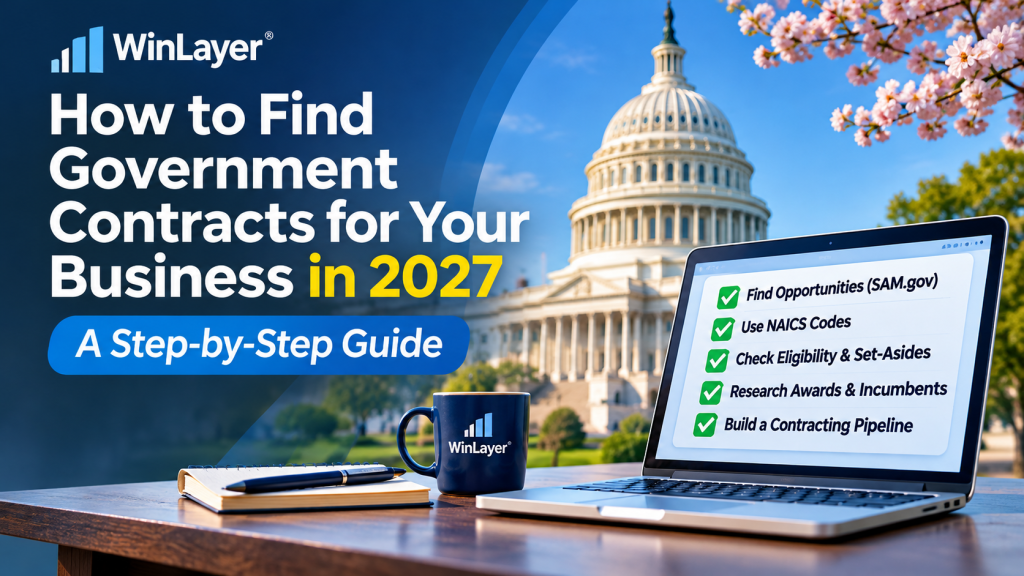
Every year, federal agencies purchase products and services from businesses of different sizes and industries. From IT support and cybersecurity to construction, equipment supply, professional services, and facility maintenance, government contracting presents opportunities for companies capable of meeting federal requirements.
But finding the right contract is often harder than finding a contract.
A business owner might spend hours searching SAM.gov, opening solicitation documents, checking eligibility requirements, and researching agencies – only to discover that an opportunity is unsuitable, too competitive, or too close to its deadline.
The better approach is to build a repeatable process for finding, evaluating, and pursuing federal opportunities.
This guide explains how to find government contracts in 2027, including where to search, how to use NAICS codes, how to research previous awards, and how to identify potential opportunities before formal solicitations appear.
1. Make Sure Your Business Is Ready to Pursue Federal Contracts
Before submitting bids, confirm that your company meets the basic requirements for federal contracting.
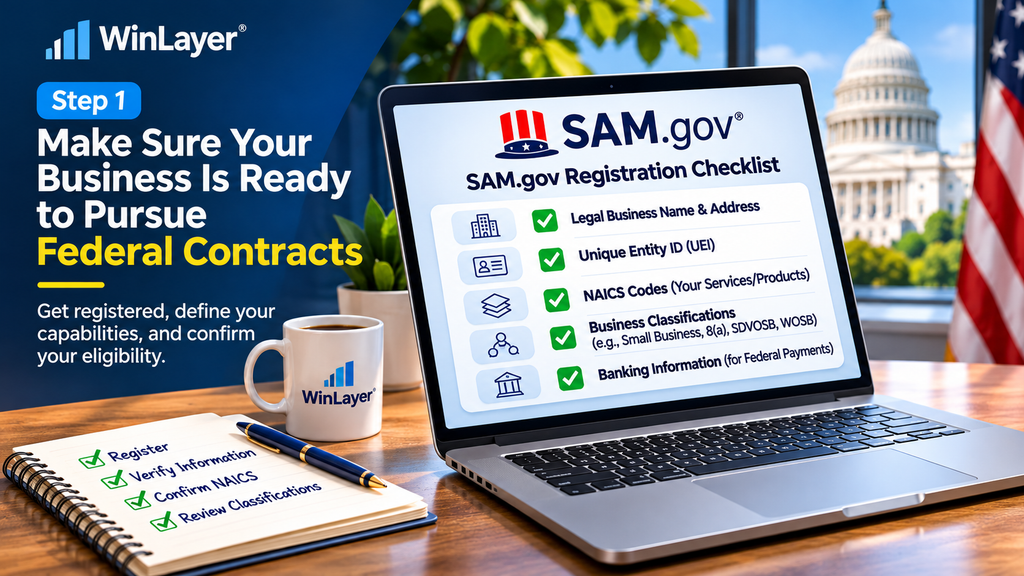
Register your business in SAM.gov
The System for Award Management, or SAM.gov, is the federal government’s official platform for entity registration and contract opportunities.
Most businesses seeking direct federal contract awards must maintain an active SAM.gov registration.
You will generally need information such as:
- Your legal business name and physical address
- Taxpayer identification information
- Banking information for federal payments
- Your Unique Entity ID (UEI)
- Relevant North American Industry Classification System (NAICS) codes
- Ownership and business classification information
Important: SAM.gov registration is free. You do not need to pay a third-party company to register.
Start at SAM.gov.
Understand your business capabilities
Registration alone does not make a company competitive.
Before searching for opportunities, define what your business can actually deliver.
Consider these questions:
- What products or services can we provide?
- Which industries do we have experience serving?
- What geographic areas can we support?
- Can we handle federal delivery timelines?
- What contract sizes can we realistically execute?
- Do we have relevant certifications, licenses, or past performance?
Your answers will help determine which opportunities deserve your attention.
2. Find Government Contracts on SAM.gov
SAM.gov is the primary starting point for publicly advertised federal contracting opportunities.
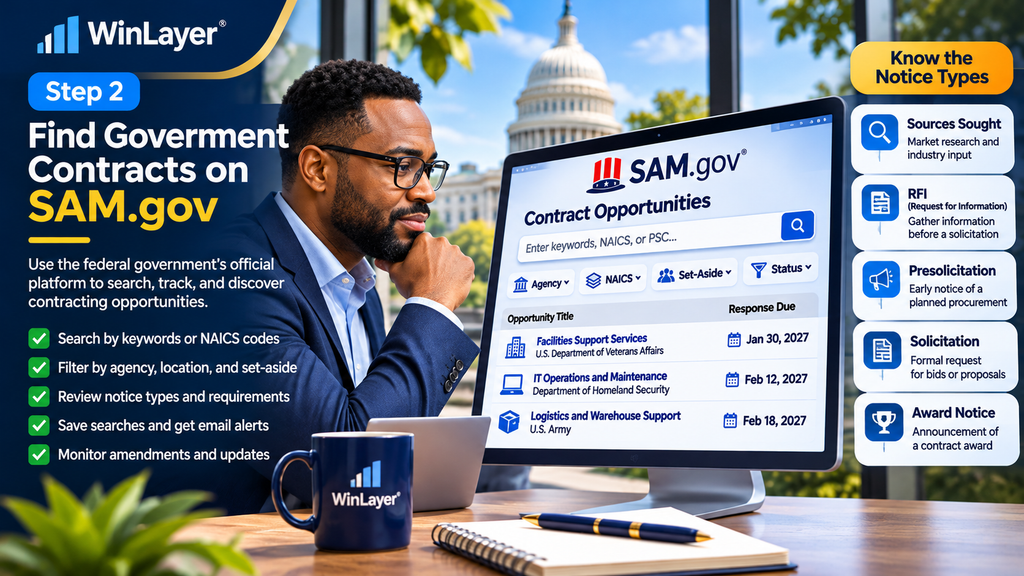
Visit SAM.gov Contract Opportunities and begin searching by keywords, NAICS codes, federal agencies, or other available filters.
For example, a company providing commercial cleaning services might search for:
- Janitorial services
- Custodial services
- Building cleaning
- Facility maintenance
Searching for only one phrase may cause you to miss relevant opportunities that use different terminology.
Understand the different notice types
Not every notice represents a contract you can immediately bid on.
Sources Sought: Agencies are conducting market research to understand which businesses may be capable of meeting a requirement.
Requests for Information (RFIs): Agencies are seeking industry feedback or information before finalizing acquisition requirements.
Presolicitation Notices: Agencies are announcing an anticipated procurement before issuing the complete solicitation.
Solicitations: Agencies are requesting bids, quotes, or proposals under specified instructions and deadlines.
Award Notices: Agencies are reporting contract award information. These can be useful for competitor and incumbent research.
For contractors building a future pipeline, Sources Sought notices and presolicitation announcements can be especially valuable.
They provide opportunities to learn about agency needs before a final solicitation is released.
Save searches and monitor changes
A productive search process should not depend on remembering to repeat the same searches every morning.
Create a SAM.gov account to save searches and follow relevant notices.
Monitor amendments carefully. Agencies may change deadlines, technical requirements, attachments, or evaluation criteria after publishing an opportunity.
3. Search Using NAICS Codes-But Don’t Rely on Them Alone
NAICS codes classify businesses and industries based on their economic activities.
Federal agencies use NAICS codes to categorize acquisitions and determine applicable small-business size standards.
For example, companies operating in professional services, construction, manufacturing, or information technology may have multiple relevant codes depending on their actual capabilities.
A common mistake is searching only under a company’s primary NAICS code.
That can be too restrictive.
An agency may categorize a procurement differently from the way a contractor describes its business.
A better search strategy
Combine three search dimensions:
NAICS codes: Identify the industry categories associated with the requirement.
Keywords: Search for the actual products, services, and outcomes the agency needs.
Product Service Codes (PSCs): Use procurement classifications to identify related purchases and historical contracts.
Suppose your company supplies technology equipment and provides installation services.
A search limited to one NAICS code may miss opportunities categorized around installation, maintenance, or broader systems integration.
Instead, create several related searches that reflect the work your business can perform.
Remember that a matching NAICS code does not automatically establish eligibility. The solicitation’s requirements, applicable size standard, and other restrictions still matter.
4. Find Opportunities Before They Become Solicitations
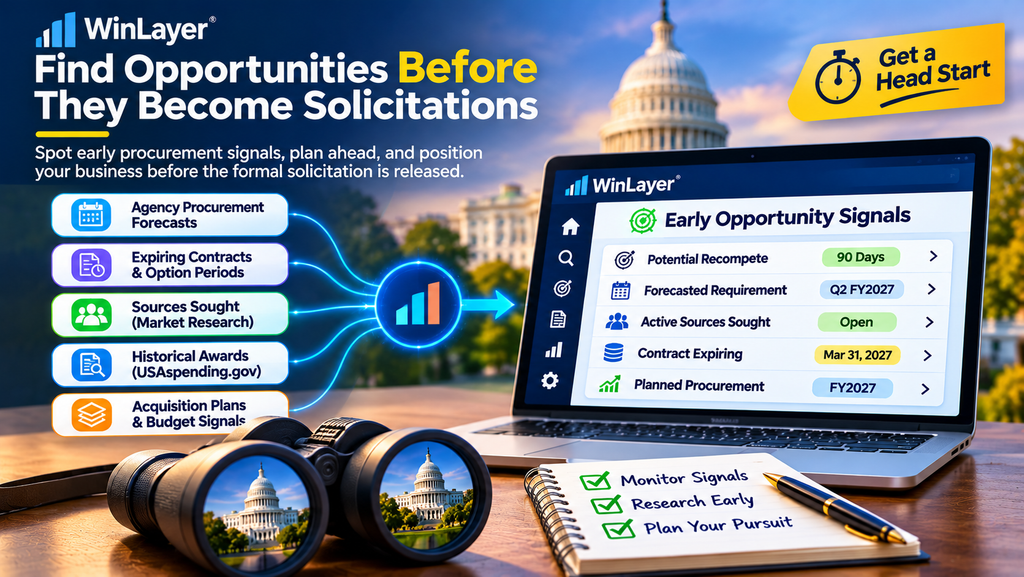
One of the biggest limitations of searching only active solicitations is timing.
By the time a formal solicitation appears, other contractors may already have researched the agency, identified potential teaming partners, and prepared their capture strategies.
That doesn’t mean late entrants cannot compete. It means earlier preparation can provide an advantage.
Review federal procurement forecasts
Many federal agencies publish forecasts of anticipated acquisitions.
These may include:
- Expected procurement descriptions
- Estimated acquisition timelines
- Anticipated contract values
- NAICS codes
- Planned small-business set-asides
- Agency points of contact
Agency forecasts are useful for planning, but they are not binding commitments. Requirements, dates, acquisition strategies, and funding may change.
Start with the procurement forecast resources provided by GSA and individual federal agencies.
Monitor expiring contracts and potential recompetes
A recompete occurs when an agency competes a requirement again, often as an existing contract approaches the end of its performance period.
Historical contract information can reveal:
- Which company currently holds a contract
- When the award was made
- The reported contract value
- Contract modifications
- Performance periods
- Potential option periods
- The agency and office responsible for the purchase
However, an approaching contract end date does not guarantee a new solicitation.
An agency might extend a contract, consolidate requirements, use an existing contract vehicle, change the scope, or discontinue the requirement.
Treat expiration dates as research signals—not confirmed future opportunities.
5. Research Previous Federal Contract Awards
Finding an opportunity is only one part of the process.
You also need to understand the federal buyer and the competitive environment.
Two valuable resources are USAspending.gov and SAM.gov Contract Data.
These systems help contractors examine historical federal purchasing activity.
What should you research?
Start with the agency issuing the opportunity.
Investigate:
Past contract awards: Has the agency purchased similar products or services before?
Incumbent contractors: Which businesses have previously performed the work?
Award values: What amounts have been reported for comparable requirements?
Contract history: Has the requirement been renewed, modified, or competed previously?
Acquisition patterns: Does the agency frequently use small-business set-asides, contract vehicles, or particular purchasing offices?
For example, suppose you discover a solicitation for equipment maintenance.
Historical awards may help you identify the previous contractor, the agency’s purchasing history, and whether similar work has been acquired through purchase orders or larger contracts.
This research provides context for your pricing, teaming, and pursuit strategy.
Be careful when interpreting award values. Reported obligations, ceiling values, and potential contract values are different measures and should not be treated as interchangeable.
6. Check Whether Your Business Is Actually Eligible
A relevant opportunity is not necessarily an eligible opportunity.
Before investing time in a response, check the solicitation for mandatory conditions.
These may include:
- Small-business size requirements
- 8(a), HUBZone, WOSB, or SDVOSB restrictions
- Required licenses or certifications
- Security clearance requirements
- Geographic restrictions
- Mandatory experience or technical qualifications
- Contract vehicle eligibility
- Submission instructions and deadlines
For set-aside opportunities, verify your eligibility under the applicable SBA rules and the specific solicitation.
Do not assume that a business qualifies simply because its SAM.gov profile contains a particular classification.
Also distinguish mandatory requirements from evaluation preferences. A missing mandatory qualification may disqualify your company, while a weaker competitive factor may affect your score without making you ineligible.
7. Make a Bid-or-No-Bid Decision Before Writing a Proposal
One of the most expensive mistakes in government contracting is pursuing every opportunity that looks relevant.
Preparing a federal proposal can consume significant time and resources.
Before deciding to bid, evaluate the opportunity systematically.
| Evaluation factor | Question to answer |
|---|---|
| Eligibility | Are we permitted to compete? |
| Capability fit | Can we deliver the required work? |
| Past performance | Can we demonstrate relevant experience? |
| Competition | What do we know about the incumbent and likely bidders? |
| Financial capacity | Can we support performance and cash-flow requirements? |
| Proposal effort | Do we have enough time and resources to respond? |
| Strategic fit | Does this opportunity support our long-term business goals? |
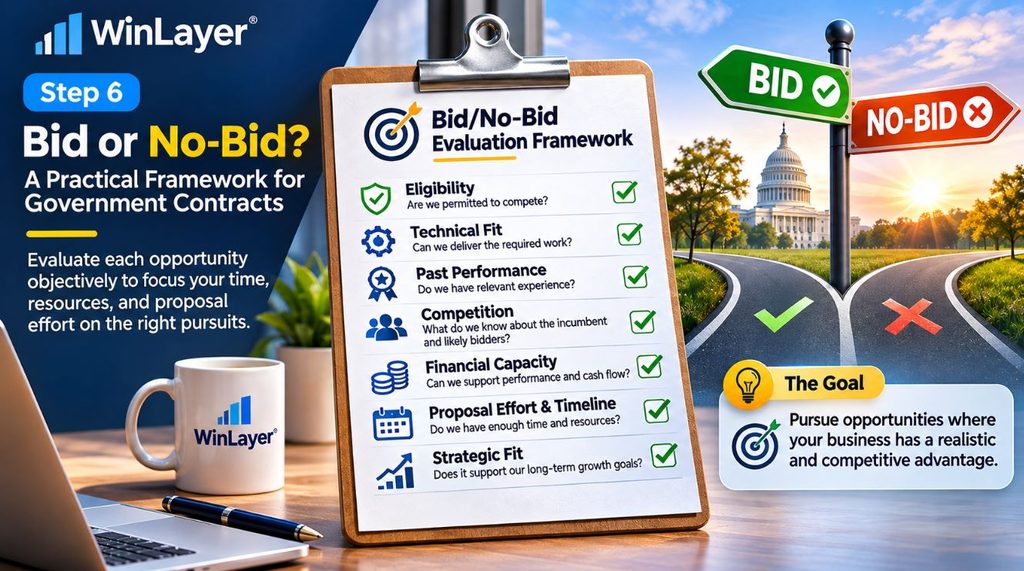
A contract with a large potential value may still be a poor pursuit if your company lacks the required capabilities or cannot meet the deadline.
Conversely, a smaller contract that closely matches your expertise may be a more practical opportunity to pursue.
The goal is not to bid more frequently.
The goal is to pursue opportunities where your business has a credible reason to compete.
8. Build a Repeatable Government Contracting Pipeline
Government contracting should be managed as an ongoing business development process rather than a series of disconnected searches.
A practical pipeline might include these stages:
Discovery: Identify relevant opportunities, agency forecasts, and procurement signals.
Research: Review the buyer, requirement, incumbent, award history, and acquisition context.
Qualification: Confirm eligibility, capability fit, and commercial viability.
Capture: Develop the pursuit strategy, identify partners, and organize the information needed to compete.
Proposal: Prepare and review the response according to the solicitation requirements.
Submission and follow-up: Submit through the designated channel, monitor communications, and track the outcome.
Keeping these stages organized makes it easier to prioritize opportunities, assign responsibilities, and avoid missed deadlines.
Even a small contracting business can benefit from a structured pipeline.
9. How AI Can Help With Government Contract Discovery
Federal procurement information is spread across multiple systems, including SAM.gov, USAspending.gov, agency forecasts, and public contracting records.
Connecting these sources manually can require substantial effort.
AI-assisted tools can help contractors organize information, summarize lengthy documents, identify potentially relevant opportunities, and support early qualification research.
But AI recommendations should not be treated as verified facts simply because they sound confident.
An effective system should distinguish:
- Confirmed solicitation requirements
- Historical contract information
- Forecasts and preliminary signals
- Inferences that require further investigation
It should also allow users to inspect the underlying evidence before making important pursuit decisions.
Where WinLayer fits
WinLayer is being developed as an AI-powered growth and opportunity intelligence platform for government contractors.
Its approach brings together federal opportunity discovery, company capability information, procurement intelligence, and capture workflows.
The goal is to help contractors move beyond searching for listings toward understanding which opportunities fit their businesses and what actions to take next.
WinLayer is designed around a simple idea: government contractors need more than a list of solicitations. They need the context to make better pursuit decisions.
Features and coverage may evolve as the platform develops.
10. Your First 30 Days: A Practical Action Plan
If you’re just getting started, use the following schedule to establish a repeatable opportunity-discovery process.
Week 1: Prepare your company
Review your SAM.gov registration, NAICS codes, business capabilities, certifications, and capacity.
Create a clear description of the products or services your company can deliver.
Week 2: Research the market
Identify three to five federal agencies that purchase what you sell.
Review relevant historical awards and procurement forecasts.
Look for patterns in buying offices, contract types, and incumbent vendors.
Week 3: Build your opportunity list
Create saved SAM.gov searches using relevant keywords and classifications.
Identify active solicitations, Sources Sought notices, and potential future opportunities.
Record the requirements, deadlines, and agency contacts.
Week 4: Qualify and prioritize
Review your opportunities against mandatory eligibility requirements.
Select a manageable number of realistic pursuits.
For each one, identify the next action: conduct more research, contact an agency representative through an appropriate channel, seek a teaming partner, prepare a response, or decline the opportunity.
By the end of the month, you should have more than a collection of bookmarked solicitations.
You should have the beginning of a structured government contracting pipeline.
Frequently Asked Questions
Where can I find government contracts for free?
SAM.gov is the primary free federal platform for finding publicly advertised contract opportunities. Agency procurement forecasts, USAspending.gov, and SBA resources also provide useful research information.
Do I need an LLC to bid on government contracts?
An LLC is not universally required. Different legally established business structures may participate, provided they meet the applicable registration, tax, licensing, and solicitation requirements.
Can a new business win a federal government contract?
Yes. New businesses can compete for opportunities they are eligible and capable of performing. However, some solicitations require relevant experience or past performance, and newer businesses may need to consider subcontracting or teaming strategies.
Can I search for contracts without registering in SAM.gov?
Yes. You can search public contract opportunities without an active entity registration. However, active SAM.gov registration is generally required to receive a direct federal contract award, subject to applicable exceptions.
How do I find government contracts before they are advertised?
Research agency procurement forecasts, Sources Sought notices, historical awards, incumbent contract periods, and acquisition planning information. These can provide early indications of potential requirements, but they do not guarantee a solicitation.
How do I know whether a government contract is worth bidding on?
Assess eligibility, technical capability, past performance, competition, proposal cost, available resources, and strategic fit. A disciplined bid-or-no-bid process helps prevent wasted effort.
Final Thoughts: Find the Right Opportunities, Not Just More Opportunities
Government contracting rewards preparation, research, compliance, and disciplined execution.
Searching SAM.gov is an important starting point, but sustainable business development requires a broader view of the federal market.
The contractors who build repeatable processes for monitoring agencies, researching awards, evaluating requirements, and preparing early are better positioned to make informed pursuit decisions.
Start with the official data. Understand your capabilities. Research the buyer. Qualify each opportunity before committing resources.
And remember: finding a contract is not the same as finding the right contract.
Ready to build a smarter government contracting pipeline?
Explore WinLayer and learn how AI-powered procurement intelligence can support your federal contracting growth strategy.
Disclaimer: This article provides general educational information and is not legal, procurement, or eligibility advice. Always consult the current solicitation, applicable federal regulations, and official agency guidance.